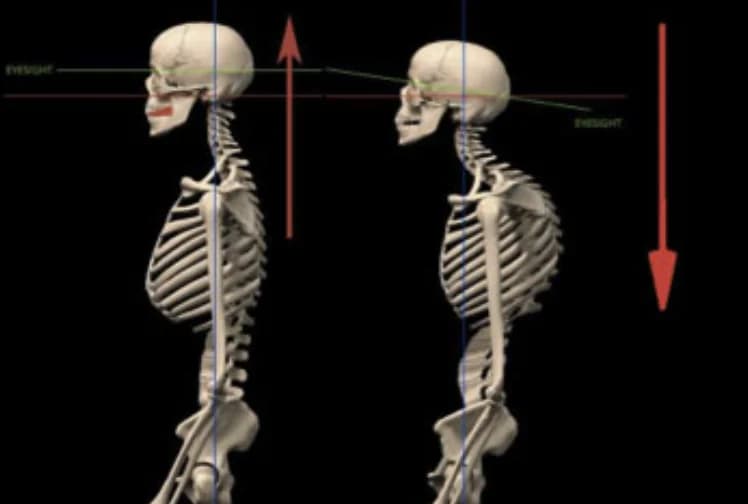
The Connection Nobody Told You About
You've spent years hearing your facial asymmetry was a cosmetic, genetic, quirk. But you can feel, literally in your body, that your scoliosis and your facial asymmetry are connected. That suspicion is completely warranted.
Here's what nobody connected for you: the crooked face you see in the mirror and the asymmetry running down your spine are not two different conditions. They are the same condition, expressed at opposite ends of your body. The cranial distortion that twists your spine is the same cranial distortion that pulls one cheek wider, drops one eye lower, and tilts your smile.
Once you understand the mechanism, you stop seeing them as separate problems and start seeing them as a single structural collapse — one that begins in the skull and cascades downward through every joint in your body.
This article walks you through that mechanism, the evidence behind it, and what it actually means if you're staring at a face in the mirror that doesn't quite match itself.
The Foundation: Your Skull Sits on a Scaffold
Your skull is not balanced on your spine the way a ball balances on a stick. It rests on the atlas (C1 vertebra) — and the structure that keeps it level is your bite.
The dental arches function as scaffolding. During every swallow, every chew, every clench, the skull's weight transfers downward through your teeth. The molars carry most of the load — that's why they're larger than the incisors. The first molar bears the single greatest weight transfer in the entire dental system.
When the scaffold is even, the skull sits level on the atlas. When the scaffold collapses on one side — through tooth extraction, asymmetric wear, maxillary cant, or premolar removal during orthodontic treatment — the skull tilts. And once the skull tilts, the entire body has to compensate.
This is the foundation of everything that follows. Get this one premise right, and the rest of the cascade becomes obvious.
The Cascade: From Skull Tilt to Spinal Curve
The progression from a small dental imbalance to full-body scoliosis happens in predictable stages — and at every stage, the originating event is the same: uneven dental height → skull tilt → body twist.
Stage 0 begins with reduced dental height somewhere in the jaw. The skull loses support on one side. There are no visible symptoms yet.
Stage 1 is when the skull tilts toward the side with less dental height. The opposite shoulder rises as a counterweight — your body's first attempt to keep your eyes level with the horizon. The pelvis begins rotating subtly. Most people feel nothing.
Stage 2 becomes visually noticeable. The skull leans further. The shoulder hikes higher. The pelvis rotates more. The chin-hyoid muscles develop asymmetrically, and neck symptoms begin. Conventional medicine often dismisses this stage as "within normal range."
Stage 3 is when the skull rotates while the jaw fights to stay parallel to the ground. Back muscles stretch behind the spine. Curves develop. Herniated discs, GI problems, and even psychological symptoms appear as the nervous system runs through compromised pathways.
Stage 4 is full compensation mode. Severe spinal curvature. Rib cage in chronic spasm. One leg appears shorter than the other. Severe neck pain becomes daily.
If you recognize yourself anywhere in this progression, you're not imagining it. Your body is following a predictable mechanical script — one that started in your skull long before it showed up in your spine.
Why the Same Distortion Shows Up on Your Face
Here's where the picture sharpens. The skull is not a single fused bone — it's an assembly of bones connected at sutures and at one critical joint called the sphenobasilar symphysis (SBS), where the sphenoid bone (behind your central face) meets the occipital bone (back of your skull).
The SBS is cartilaginous. It moves. And every bone in your face — including the maxilla, which determines the position of your nose, eyes, cheekbones, and upper teeth — is anchored to the sphenoid. So when the SBS shifts, your face shifts with it.
Three patterns dominate. Each one shows up simultaneously as facial asymmetry and as a specific spinal pattern.
Pattern 1: Lateral Strain. The sphenoid and occipital shift sideways in the same direction. The front half of the skull literally translates to one side. On the face: one side becomes wider and more voluminous; the other flattens. One lip corner gets pulled toward the neck muscle. Eye corners droop and round out. After about age 30, a vertical wrinkle appears behind the ear on the narrow side. In the body: the skull's lateral shift pulls the cervical spine into a C-curve. The shoulder on the wider-face side typically rises. Hip alignment follows.
Pattern 2: Torsion. The sphenoid and occipital rotate in opposite directions along the same axis — like wringing out a towel. On the face: eyes appear on the same horizontal line, but the jaw line is shifted. Years of torsion produce uneven dental height, which is why this pattern is the hardest to fix — the compressed dental side has fundamentally lost vertical structure. In the body: spinal rotation, often a rotational scoliosis where vertebrae twist around their own axis rather than just curving laterally.
Pattern 3: Side-Bending Rotation (SBR). The cranial base bends to one side and the sphenoid rotates with it. On the face: one side narrower, the other wider. Eyes are not on the same horizontal line. The dental midline is shifted. During tongue posture work, the tongue presses asymmetrically against the palate. In the body: classic scoliotic curve with concurrent pelvic rotation. One leg often appears shorter.
These are not three separate diagnoses. They are three signatures of the same underlying problem: the SBS has lost its neutral position, and every structure attached to it — face above, spine below — distorts accordingly.
The Evidence: This Isn't Speculation
The bite-posture connection has been demonstrated experimentally across multiple study designs. This isn't a fringe theory. It's a load-bearing structural relationship that mainstream orthopedics has failed to acknowledge.
The Chilean splint study (1983). Researchers added 4–8mm of bite height to subjects via dental splints. Within 72 hours, symptom reduction averaged 50%. After three weeks, more than 70% improvement was reported in neck pain, TMJ pain, headaches, tinnitus, and dizziness. The only intervention was raising the bite — which raised and re-leveled the skull, which released the cervical compensation.
Animal experiments. Studies on mice demonstrated that removing teeth or adding fillings to alter bite height produced measurable changes in spinal curvature. Cause and effect, in a controlled setting: alter the dental scaffold, alter the spine.
Athletic performance studies. Dental splints have been shown to eliminate lumbar pain and increase quadriceps strength in athletes — without any direct intervention on the legs or back. The only thing changed was the bite plane.
Atlas-jaw research. Manual correction of the atlas vertebra produces temporary improvements in jaw position and overall body symmetry. But here's the critical finding: if dental occlusion is distorted, the atlas refuses to hold its correction. The bite pulls it back out of alignment. This proves directionality. The bite is upstream of the atlas; the atlas is upstream of the spine.
The Simone Cincini case. A former professional footballer with severe full-body asymmetry: left skull deviation, nose deviated left, left eye dropped, left cheekbone overdeveloped. His sagittal dental height deficit had caused his skull to sag backward, compressing his spine and — remarkably — compressing his pituitary gland. His gonadotropin hormones (LH and FSH) measured at 0.2 and 0.0, near zero. After Starecta dental splint therapy, his hormones returned to normal ranges (9.7 and 6.5), his posture corrected, and his spine decompressed. A bite intervention produced an endocrine recovery.
Each piece of evidence points the same direction. The skull-bite-atlas-spine chain is not a metaphor — it's mechanical reality.
Forward Head Posture Is the Bridge
Between facial collapse and spinal collapse sits one intermediate phenomenon: forward head posture.
When the maxilla is set back or canted, the midface loses its vertical support. The skull's center of gravity shifts forward. The atlas can no longer hold the skull on the body's vertical axis. For every centimeter the head falls forward, the neck and back muscles must compensate for roughly 2kg of additional load. And you can feel that in your body, in your shoulders, when you bend and when you breath.
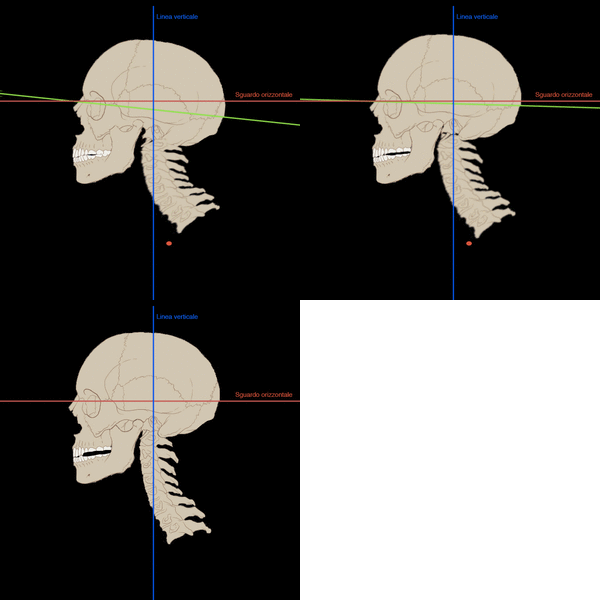
This is why forward head posture isn't really caused by phones or desks. Phones and desks accelerate it, but the underlying vulnerability is structural — a skull that has lost its scaffold. People with intact maxillary support and a level bite plane don't develop forward head posture from screen time. People with collapsed maxillas develop it inevitably.
And the forward head is the engine that drives spinal curvature downward through the chain: rounded shoulders, thoracic kyphosis, deepened lumbar lordosis, pelvic tilt, scoliotic compensation, and eventually leg-length asymmetry and foot pronation patterns. The same forward drift that flattens your midface and drops your cheekbone is the drift that's curving your spine.
What This Means If You Have Facial Asymmetry
If your face is asymmetric, you almost certainly have body-level asymmetry too — even if you can't feel it yet. The face is simply where the distortion is most visible, because faces are what we look at. Your spine has been twisting along the same vector the whole time.
This reframes facial asymmetry from a cosmetic concern into a structural diagnostic. The asymmetric face is not the problem — it is the visible signal of a whole-body cranial distortion. The same intervention that addresses one addresses the other.
The reverse is also true. If you've been diagnosed with scoliosis and have never been told to look at your bite, your maxilla, or your cranial structure, you've been working downstream of the actual cause. Bracing the spine while the skull continues to tilt is like leveling a house by adjusting the furniture instead of fixing the foundation.
Mainstream orthopedics will keep handing you back braces, posture cues, and "core strengthening" routines. None of them touch the upstream cause. None of them ask why your skull tilted in the first place.
The Direction of Treatment: Reversing the Cascade
The implication of everything above is straightforward: the chain reverses through the same path it formed. Address the cranial distortion, and the body re-stacks itself.
Tongue posture. The constant upward and forward pressure of the tongue against the palate is the primary force that develops the maxilla forward and prevents future collapse. Without it, no other intervention holds.
Bite leveling. Through dental splints, ALF orthodontics, methods like Starecta that act as a lever on the molars to lift and re-center the skull, or even a $13 flat mouthguard. The goal is the same — restore vertical dental height so the skull stops tilting.
Suture mobility work. Cranial sutures remain movable throughout life — Heisey and Adams measured 17–70 microns of bone motion in living tissue under directional force, and Retzlaff's cadaveric histology found intact vascular and neural networks inside sutures of elderly adults. Structural change is possible at any age.
Asymmetric correction. Equal effort on both sides reinforces existing distortion. Effective protocols target the specific pattern — lateral strain, torsion, or side-bending rotation — that the person actually has. This is where most generic mewing and face yoga routines fail.
Atlas integration. Address the atlas alongside the bite. The bite holds the atlas's correction in place; intervening on either alone won't stick.
Neck traction. The main exercise we recommend. It has been shown to improve spinal curvature by up to 20 degrees in only a few months — a magnitude of change conventional physiotherapy rarely produces.
The face and the spine respond together because they were never separate problems. They are the upper and lower expressions of one central truth.
The Bottom Line
Facial asymmetry is not cosmetic. Scoliosis is not orthopedic. Both are postural, both originate in the cranial-dental relationship, and both are visible signatures of the same underlying distortion in the sphenobasilar symphysis.
The asymmetric face you see in the mirror is not telling you about your face. It's telling you about your skull, your bite, your atlas, and your spine.
Read the signal. The whole body is in it.
→ [Start the assessment](/assessment)