The Moment You First Noticed
It's never gradual. It's never a slow, creeping suspicion. It's a single frame — your phone's front camera catching you mid-laugh, or a candid photo from a friend's birthday where your left cheekbone shoots higher than your right, pulling your smile into something you barely recognize. You stare. You flip the photo. You open the mirror app and line yourself up against the version you've always known — the reversed version, the comfortable version — and suddenly, nothing matches.
You start checking everything. Old photos. The mirror at different angles. Video calls you've been dodging for months because, if you're being honest, you hate the way your face looks on screen. You notice it more now: the way one side of your mouth doesn't lift quite the same as the other, the way your left eye seems to sit in a different plane of your skull, the way one cheekbone higher than other isn't just a passing observation — it's the axis your entire self-image has started to orbit around.
And then comes the question, typed at 2 AM into a search bar you hope no one ever sees: why is my face lopsided? You're not looking for sympathy. You're looking for a cause. And more importantly, you're looking for something you can actually do about it. Because everyone around you says, "You're being dramatic — nobody notices." But the camera doesn't lie. And neither does the exhaustion you feel from constantly holding your face in a posture that feels almost right but never quite symmetrical.
Here's the thing nobody told you: your face isn't broken. It isn't a genetic sentence. And it isn't permanent — not if you understand the mechanism behind what's happening to your skull right now and how to reverse it.
This article walks you through exactly that. Not the filler route, not the surgery route, not the face yoga route. The mechanical route — the one grounded in actual cranial bone science.
Facial Asymmetry Isn't a Cosmetic Problem — It's a Loading Problem
Facial asymmetry — including the telltale sign of uneven cheekbones where one cheekbone sits visibly higher than the other — is not a random aesthetic quirk. It is the structural output of years of small, repeated, and asymmetric mechanical loading forces that have gradually remodeled your skull. Your face doesn't just happen to grow this way. It was shaped this way, millimeter by millimeter, by forces you applied unconsciously every single day.
Think of it like a metal bar that you lean on from one side for years. Eventually, it bends. The bar isn't defective — it was shaped by sustained directional force. Your skull works the same way. The bones of your face and cranium sit at junctions called sutures, and these sutures behave more like flexible expansion joints than permanent welds. When force pushes unevenly across these joints over months and years, the bones slowly adapt their position to accommodate the pressure.
This is Wolff's Law in action: bone tissue remodels itself in response to the mechanical loads placed upon it. Increase the load on one side of your zygomatic arch — through unilateral chewing, for example — and the bone adapts by thickening or shifting on that side. Sleep on your left cheek every night for a decade, and the compressive force from your pillow gradually pushes your cheekbone downward and backward relative to the right. The result? One cheekbone higher than other when you look straight on.
The forces responsible are almost never dramatic. They're the micro-forces of daily life: chewing predominantly on one side because the other side feels "off," sleeping in the same position out of habit, resting your chin on your hand while you work at your desk, chronic mouth breathing that drops your tongue from the palate and allows the maxilla to sag asymmetrically. Individually, each of these forces is trivial. Collectively, across years, they create visible, measurable facial asymmetry.
Dr. Weston Price documented this environmental mechanism in the 1930s by studying indigenous populations whose tough, natural diets produced wide, symmetrical facial structures — and whose children, after adopting processed soft-food diets, developed dramatically narrower palates, shifted jaws, and asymmetrical facial features within a single generation. The cause wasn't genetic. It was mechanical. And the same principle applies to uneven cheekbones today.
If your asymmetry is the result of how force was applied, then the logical conclusion follows: asymmetry can also be the result of force applied in the opposite direction. Which brings us to the question of whether adult cranial bones can actually still move.
The Skull Isn't Fused — And That Changes Everything
The single most persistent myth holding people back from understanding their own facial asymmetry is the idea that the adult skull is a solid, fused helmet — that once puberty passes, your bones lock into place forever. This is what most anatomy textbooks say. It's what most dentists and doctors will tell you. And it's wrong.
In 1899, William Garner Sutherland, an osteopathic medical student, noticed that the articular surfaces of the temporal bones were "beveled like the gills of a fish" — a structural feature explicitly designed for motion, not static fusion. He tested his hypothesis by building a leather-strap device and applying pressure to his own skull, documenting measurable cranial shifts. His findings were ridiculed at the time, and mainstream medicine spent the next century treating the skull as a rigid structure.
The science eventually caught up. In the early 1990s, Heisey and Adams conducted the first rigorous in-vivo measurements of cranial bone motion in living tissue. Using multiplanar strain gauges, they documented that cranial bones move — separating, rotating, and shifting — by 17 to 70 microns under directional force. This wasn't post-mortem speculation. This was live tissue, moving under mechanical load. Their findings were published in peer-reviewed journals and effectively demolished the fused-skull dogma.
Retzlaff followed with cadaveric histology that should have been even more conclusive. Examining adult skulls well into old age, Retzlaff found intact vascular networks and nerve endings within the cranial sutures themselves. If these sutures were truly ossified and fused, those delicate neural and vascular structures would have been obliterated. Their continued existence proves, at a cellular level, that adult sutures remain biologically active, patent, and responsive to mechanical stimuli throughout life.
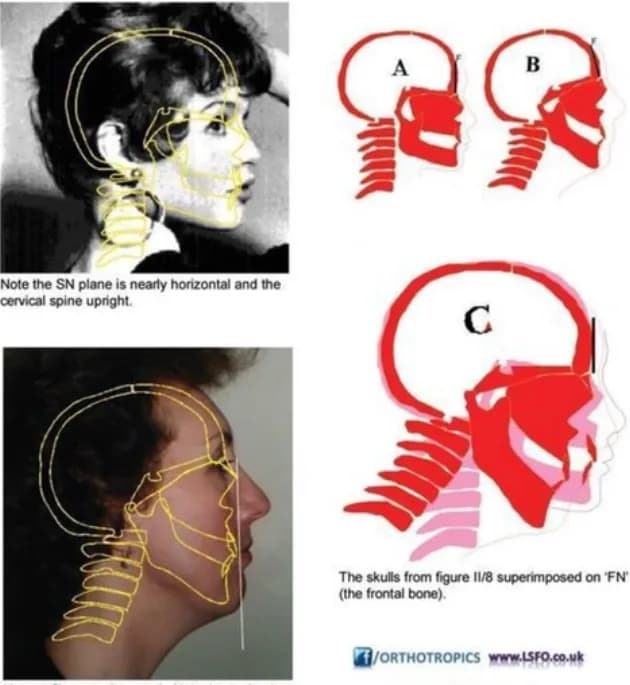
The orthotropic movement, led by Dr. John Mew and his son Dr. Mike Mew, took this foundation and applied it directly to facial structure. Their argument — that malocclusion and facial asymmetry are primarily environmental and postural, not genetic — is what eventually led to Mike Mew's 2024 tribunal and removal from the dental register. Ironically, the tribunal failed to find evidence of dishonesty or patient harm. It was, in essence, an establishment silencing a philosophy that threatened a lucrative industry built on intervention rather than correction.
The takeaway is simple but transformative: your cranial bones are still capable of adaptive movement. They were pushed off-center by years of asymmetric loading. And if force created the asymmetry, directional corrective force can reverse it. The real question isn't whether your skull can still move — it's whether you're applying force in the right direction.
Why Mewing, Face Yoga, and Gua Sha Haven't Fixed It
If Wolff's Law is real and your sutures are still mobile, why haven't all those hours of mewing, face yoga, and gua sha corrected your uneven cheekbones? The answer is specificity — or rather, the complete absence of it.
Mewing is fundamentally undirected. The protocol places the tongue against the palate and says "push." But it doesn't account for which specific cranial strain pattern your skull is stuck in. If your asymmetry follows a torsion pattern (one side of your cranium rotated forward, the other twisted backward), then a generic upward tongue thrust may actually reinforce your existing asymmetry rather than counter it. You're pushing hard, but you're pushing with your imbalance, not against it. For a deeper breakdown of how strain patterns work, see our article on identifying your cranial torsion pattern.
Face yoga is even further removed from the problem. It targets superficial muscle — the orbicularis oculi, the zygomaticus major, the masseter. These muscles control expression and mastication, not bone position. Massaging, stretching, or toning these muscles may temporarily reduce puffiness or improve skin tone, but they cannot shift the zygomatic arch, reposition the maxilla, or level a cheekbone that sits on a structurally adapted cranial base. You are treating the wallpaper and wondering why the foundation stays crooked.
Gua sha and jade rolling operate in the same domain: temporary lymphatic drainage and superficial soft-tissue manipulation. They feel good — sometimes they even make you look less puffy for a few hours — but the moment inflammation returns (which it always does), your underlying skeletal asymmetry is exactly where you left it. There is no mechanism in gua sha that applies sustained directional force to cranial sutures.
Even expensive dental appliances — ALF devices, DNA appliances, homeoblocks — routinely fail for structural reasons. These tools are tooth-borne, meaning they transmit force through the dentition rather than the cranial skeleton. The teeth tip outward through the alveolar bone while the maxilla barely budges, leaving patients with open bites, wrecked occlusion, and zero improvement to their underlying facial asymmetry. The force went to the wrong structure entirely.
This is the critical gap: every non-surgical solution on the market either targets the wrong tissue (muscle and fascia), applies force in the wrong direction (non-specific mewing), or transmits force through the wrong path (tooth-borne splints). What's missing is a protocol that identifies your cranial strain pattern first, then applies directional corrective loading specifically to your asymmetry — not a generic routine.
The Strain-Pattern-Specific Approach: How MoveBone Works
MoveBone was built to close exactly that gap. It is not a face yoga app. It is not a mewing tracker. It is an app-guided, self-directed structural protocol that identifies your specific cranial strain pattern and prescribes directional corrective loading — the same biological mechanism (Wolff's Law) that created your asymmetry, now deliberately applied in reverse.
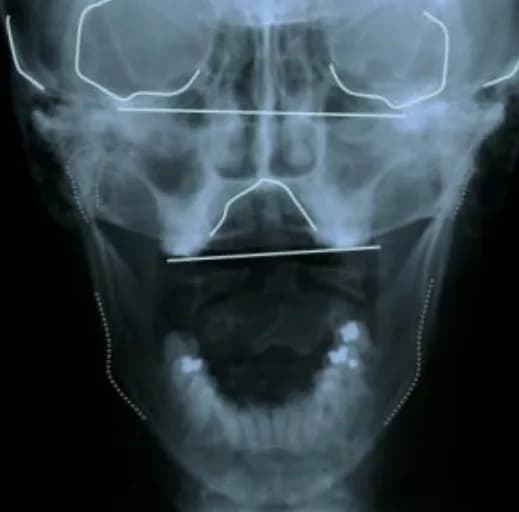
Here's how the process works. First, you complete a structured facial analysis that maps the directional imbalances in your skull — the cant of your cheekbone, the tilt of your jawline, the vertical position of each eye. From these measurements, the system categorizes your asymmetry into a specific cranial strain pattern. (Understanding how cranial sutures respond to remodeling force is essential here — it's the foundation of why pattern identification matters.) Once your strain type is identified, MoveBone generates a daily corrective protocol consisting of targeted manual pressure vectors, tongue posture sequences, and postural adjustments — each one calibrated to counter your specific direction of distortion.
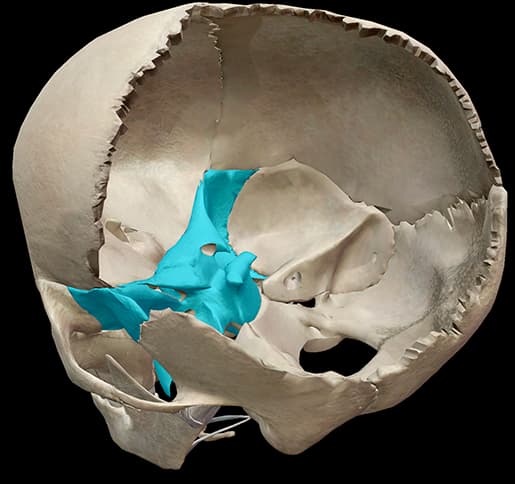
The protocols are mechanical, not muscular. You're not "exercising" your face. You're applying sustained, gentle pressure to specific cranial landmarks — the zygomatic arch, the temporal bone, the sphenoid — in precisely the vector needed to nudge your sutures back toward their neutral, symmetrical configuration. Think of it as bending the metal bar back, one degree at a time. The force is subtle enough to be sustainable, directional enough to be effective, and consistent enough for Wolff's Law to do its work.
Each protocol runs on a structured 60 to 90-day arc. Bone remodeling isn't instant — Heisey and Adams measured movement in microns — but the compounding effect of daily directional loading is measurable within weeks. MoveBone tracks structural progress through photo overlay comparison, so you can see the shift in real time. The app doesn't ask you to trust a promise; it shows you the data.
And because your strain pattern is unique, the protocol is too. Two people with the same superficial description of "my left cheekbone is higher" may have entirely different underlying torsion or lateral strain configurations. MoveBone doesn't treat the label — it treats the geometry.
The goal isn't mathematical perfection. It's structural normalization — restoring your face to the balanced, neutral configuration it was always meant to hold, before years of asymmetric loading drifted it off course.
What to Expect — And What Not to
Let's set realistic expectations from the start, because this market has been burned enough times by false promises. You are not going to see dramatic results in seven days. Cranial bone remodeling operates on biological timelines, not marketing timelines. The earliest measurable shifts typically appear around the 30-day mark, with more pronounced structural change visible between days 60 and 90. Full protocol completion runs approximately six months for comprehensive correction.
What you will notice early on is often postural. As your tongue posture improves and your cervical chain begins to decompress, you may feel a subjective lightness in your face, a reduction in jaw tension, or a sense that one side of your skull is "opening up." These are real signals — they mean the directional forces are engaging the correct structures. But they are precursors, not the final result. The bone-level change comes later.
What you will not need is surgery, fillers, expensive appliances, or any form of dental intervention. The protocol works entirely through external mechanical loading and postural correction. There are no devices to wear, no intraoral appliances to sleep with, and no recurring costs for filler touch-ups. It is a self-directed protocol that you perform at home using your own hands, your own tongue posture, and the guidance of the app.
Photo consistency is critical. The biggest mistake people make in the first month of any structural protocol is checking the mirror obsessively without documenting anything, then "forgetting" where they started. The MoveBone photo overlay tool exists for exactly this reason: take your baseline photo on day one, and trust the process while the app handles the comparison. You are your own worst evaluator in the early weeks. The data doesn't have that bias.
Also worth noting: asymmetry can be progressive. Research using three-dimensional stereophotogrammetry has demonstrated that structural facial asymmetry increases by approximately 4% per decade on average. Every year of inaction is another year of uncompensated, asymmetric loading that your skull continues to adapt to. Starting a corrective protocol now doesn't just reverse what's already happened — it halts the ongoing drift.