For anyone whose face aged 10 years after braces or aligners
Why your teeth moving sent your face collapsing left or right, and what can actually be done to raise it back
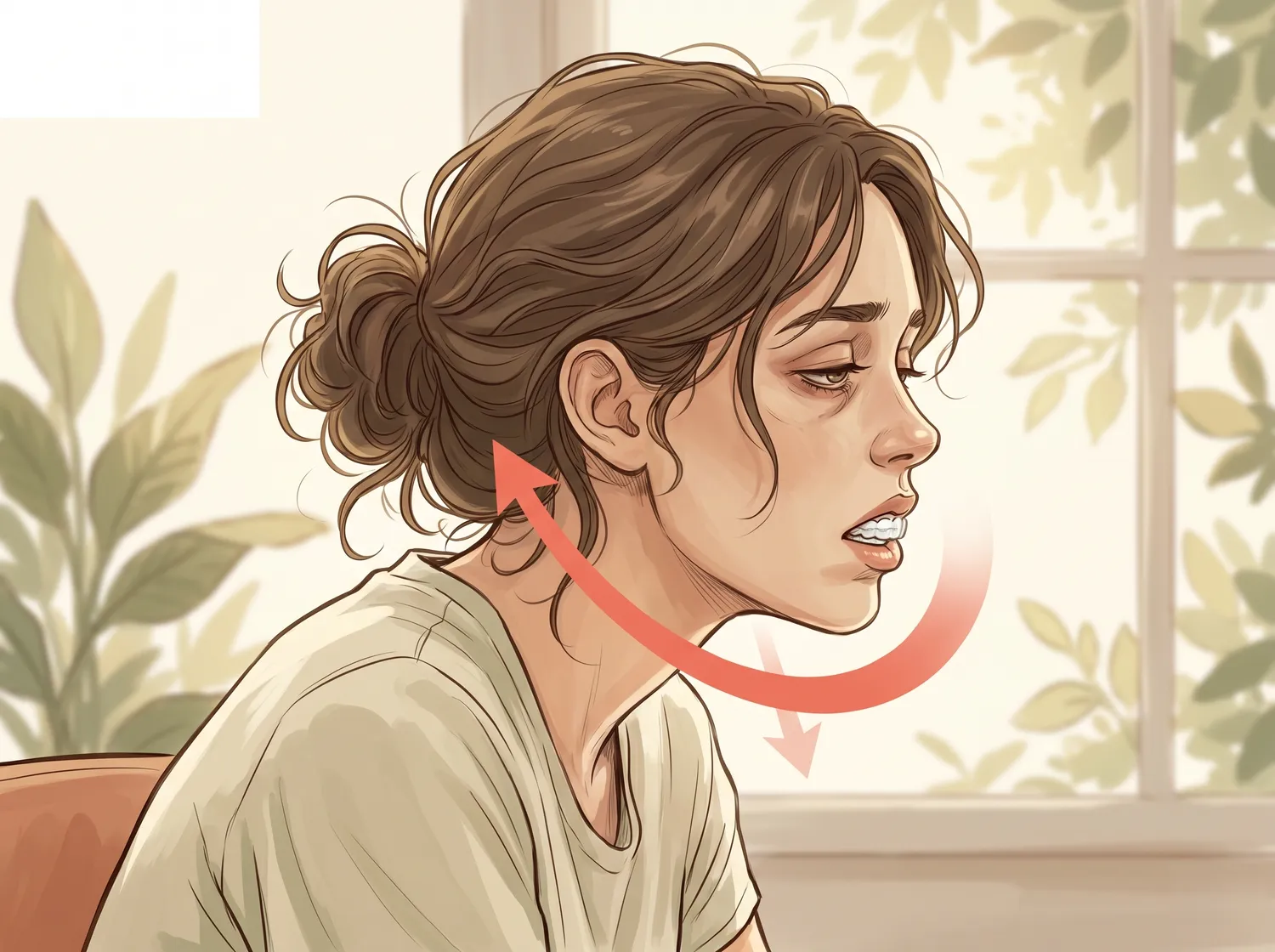
You said it changed your face. And your orthodontist told you “that's impossible”, and now you feel like you are being gaslit and taken for a fool, as if you don't know what your own face used to look like.
Or they told you nothing. A straight smile, but stuck with a face which doesn't belong to you. Would you have paid if they did?
If you are reading this, most likely you are in a similar position. That story is part of why MoveBone started
I finished my treatment with perfectly straight teeth. Within a few months I started catching my reflection and flinching. I'd had full cheeks and normal temples my whole life. Now both were sunken.
My face looked like I'd aged ten years in one. My lips, which used to be fuller, had gone thin and flat and dropped. I'd look in the mirror and it didn't even look like me. My side profiles were different, and I stopped letting people take my photo because it felt as if everything was off-center.
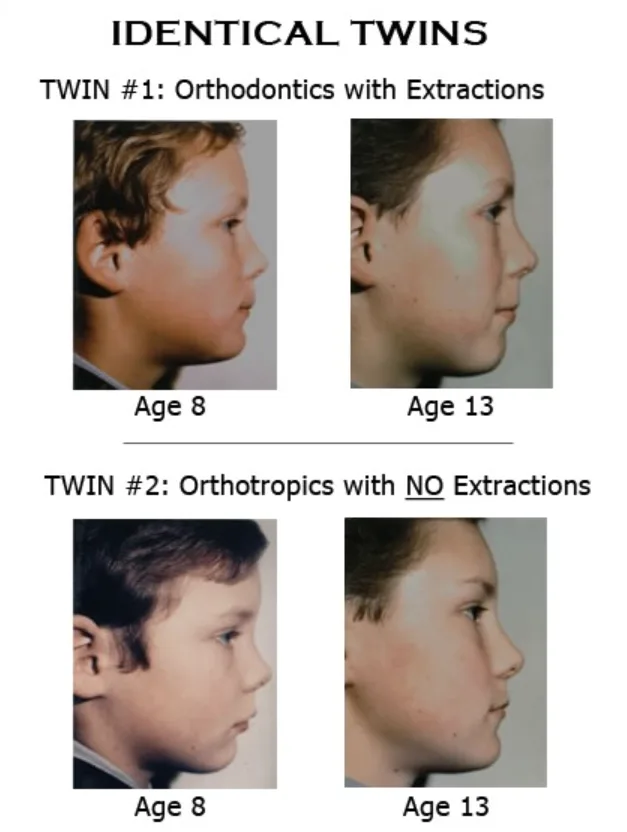
So I did what you probably did. I went to the person I'd paid and trusted, and told him my face had changed. He completely denied it. He said orthodontics cannot change your face, that it was impossible, and brushed me off like I was being dramatic.
But I had the old photos. Full cheeks, then hollow. Bright eyes, then tired. A jaw that used to sit forward, now slid back. My biggest regret, for a long time, was trusting him. I left feeling insane.
Then I went down the rabbit hole. Hard. I read everything. I tried things one after another, and each one helped a little and then stalled. I priced out fillers. I sat in a surgeon's office and almost agreed to have a bone cut. I spent close to two years and more money than I want to admit chasing the wrong fix — because I was wrong about what was actually wrong with my face.
Here is what no one told you before they moved your teeth:
Your teeth were holding your structure up.
A very complex process of fascia, spine, cranium can be summarized in that sentence.
The bones in your skull are alive. They move and remodel your entire life.
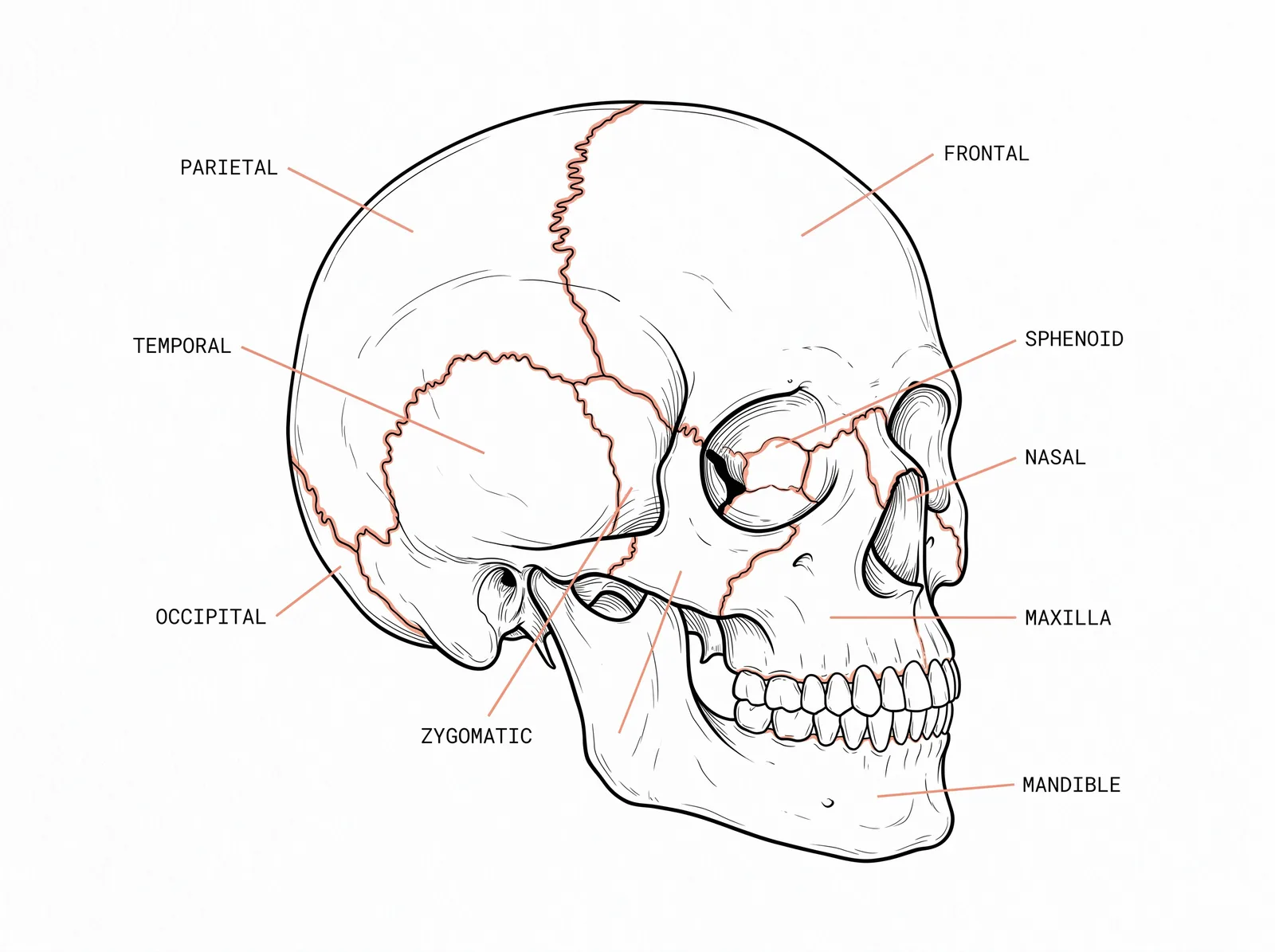
The joints between your skull bones, called sutures, are not glued shut in adults. They are living tissue, with blood and nerves running through them. They move. Only tiny amounts, but they move, your entire life (Heisey & Adams, 1993; Crow et al., 2009; Moskalenko et al., 1999). Move the bite ever so slightly, and every single bone behind it will follow. Push on them gently and steadily, and the structure shifts.
Think of your upper jaw as the keystone of your face. When braces or aligners pull your teeth back and squeeze the arch narrower, that keystone drops. It slides down and back. And the rest of the face follows it down.
Your cheekbones lose their lift. Your eyes lose their floor and start to look hollow. Your lips lose their lift and go thin and flat. Your lower jaw slides back to chase the upper one.
It did not stay in your mouth (why it might be worse than you think)
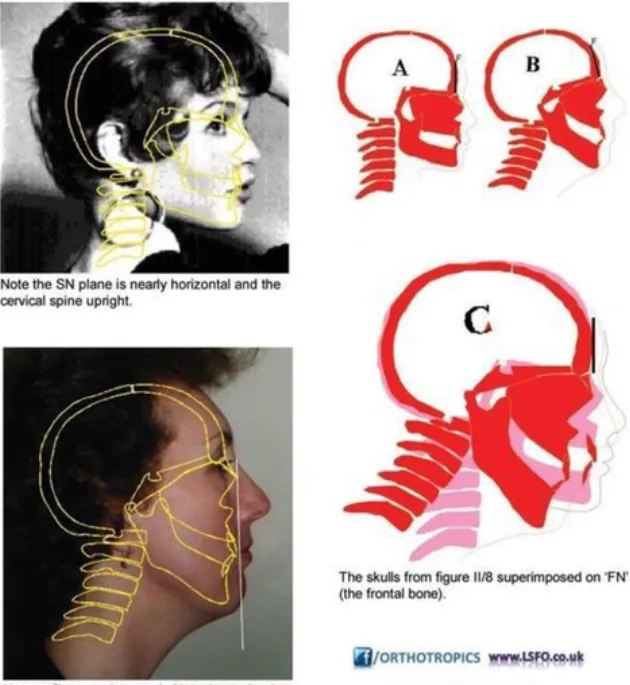
Your skull does not float. It balances on the top bone of your spine, called the atlas. The occiput (the bone at the back of your skull) twists or turns with the maxilla. So the atlas tilts to catch it.
A tilted bite tilts your whole head.
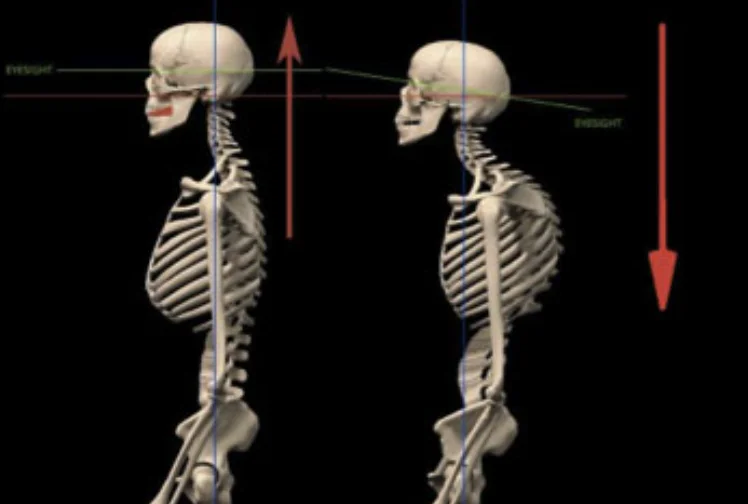
Your neck muscles shifts to hold your head up. Then your shoulders lock in tight fascia patterns, your back compresses, all the way down. Your head drifts forward. Your posture rotates to cope. Your teeth are the scaffold that keeps that balance level. That is why this came with more than a face change.
Here's the part that matters most: a collapse is never even. The teeth didn't get pulled back symmetrically. So your face didn't just drop, it dropped harder on one side and rotated. That rotation is what you see as the lopsided, one-eye-lower, crooked-in-photos look.
The sunken look and the off-center look are not two problems. The hollowing is your collapse seen from the front. The asymmetry is the same collapse seen from the side, and it's the part you can actually measure.
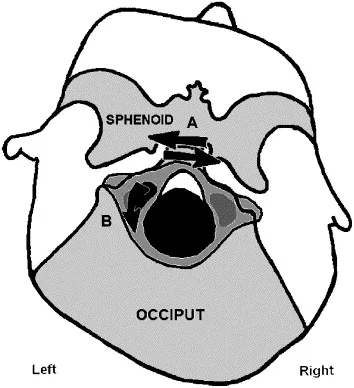
The collapse has a shape. A specific one. Maybe a twist. Maybe a lean to one side. Maybe a flat tilt.
Moving the face in the right direction
The system that did this is built to look at teeth in isolation. Teeth in one box. Eyes in another. Posture somewhere else entirely. Sleep is a different guy on a different floor. Nobody's actual job is your whole structure. So when your face fell, the one person you trusted looked at your straight teeth, called it a success, and told you the rest was in your head.
We know that bone moves, but is it possible to trigger those movements in the right direction? Yes, and here's how
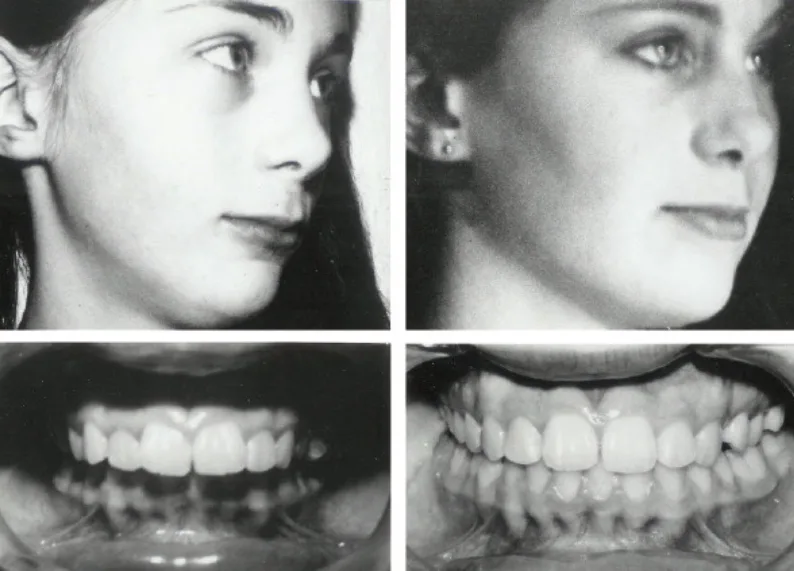
Your maxilla didn't just drop. It got locked there. The fascia tightened around it and held it down. Your posture keeps loading it. One side of your muscle keeps pulling and shortens the other weakens. And the cranial bones get's locked into a new configuration.
What you can do right now
Fascia release. The web of tissue under your skin pulls tight and uneven, locking everything where it landed. It has to be released
Posture training. Your head, neck, and tongue drift out of line, the spine, neck and pelvis bend and keep feeding the collapse.
Muscle. One side of the bite hits harder, muscles compensate, jaw pulls up, neck twists. Do a targeted release of the strained sides from temporalis to the neck.
Craniosacral therapy. The cranial bones in your skull settle and lock into the crooked shape. Cranial osteopaths touch this. They can be guided back with light consistent practice, using your own two hands (Medicina, 2022)
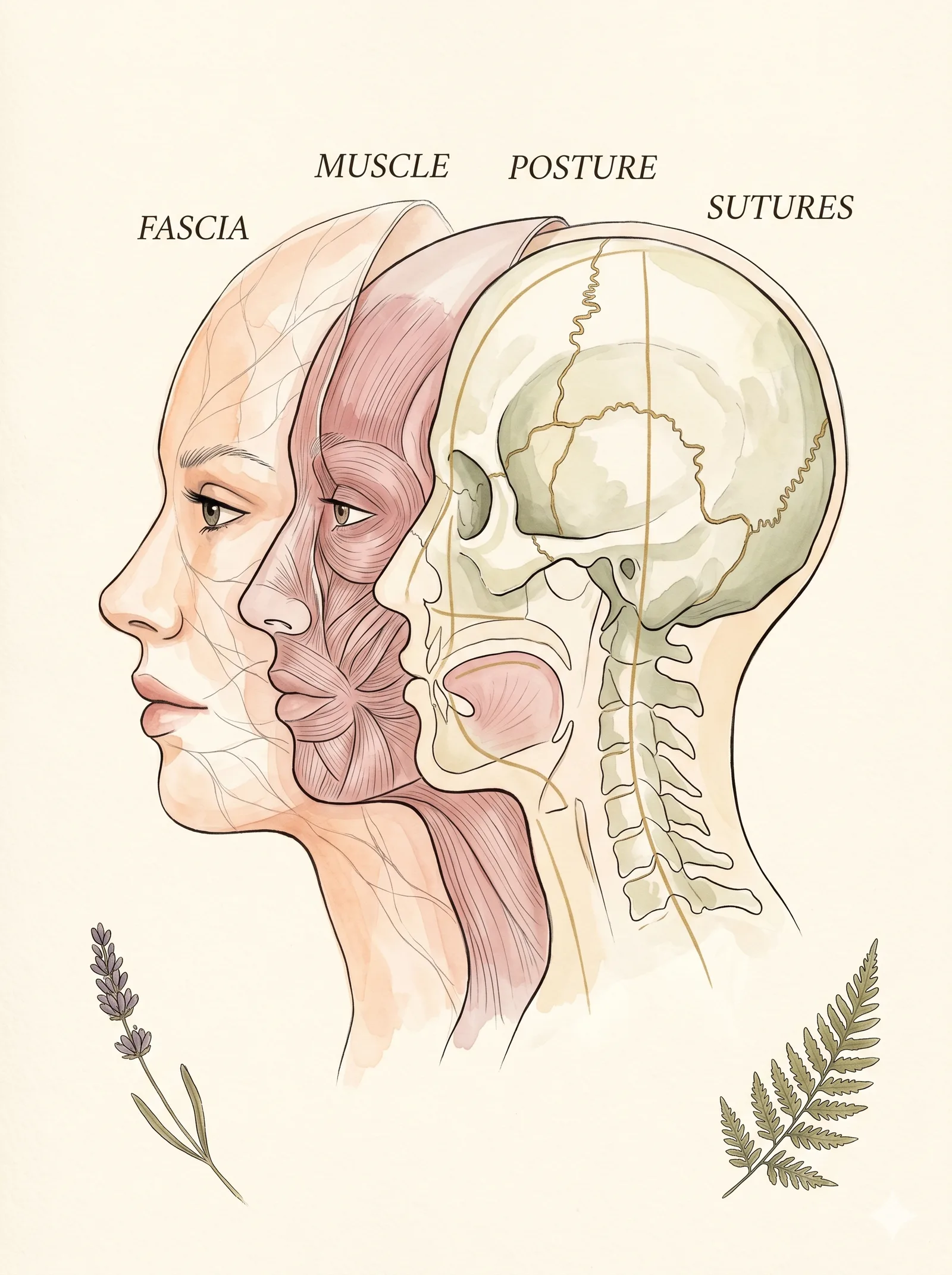
The protocol works in the order the structure actually came apart. Release the fascia that's holding it down. Retrain the posture that keeps loading it. Rebalance the muscle pulling it off-center. Then apply steady traction to the exact sutures, lifting and de-rotating back along the direction it fell. Four layers, one job: raise.
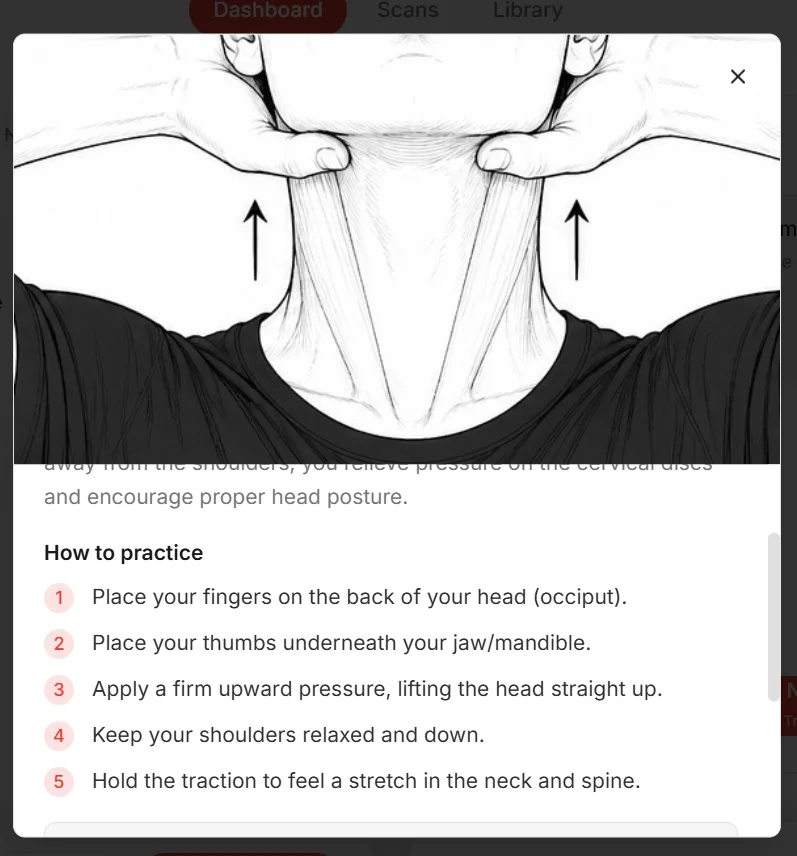
There is also a window. The suture work is most effective between roughly 20 and 45, while the joints still move most easily (Park et al., 2022). Inside that window you have the most leverage you will ever have. That is the best reason to start today.
You can't correct a collapse you can't see. So the first step is to see it.
Everything above only matters once you know which way your face actually fell. The collapse has a direction, and yours is specific to you, down to the millimeter and the degree. You cannot guess it in the mirror, and you cannot fix what you haven't measured.
So the work starts with a read. MoveBone reads your face from a single front photo the way an engineer reads a building, and maps how your cranial bones shifted: the cant, the recession, the forward-head load, and the exact side your structure fell. The same map a clinician would chart, in 90 seconds, from your phone.
That map is what tells you what to lift, and in which direction. Without it you are guessing. With it, every minute of work pushes the right bone the right way. It costs nothing.
From there, the four layers stop being a theory and become a routine. The same fascia, posture, muscle, and suture work from above, sequenced in the order your structure came apart, and aimed at your pattern specifically rather than a generic face:
- Release the fascia that locked you in place
- Retrain the posture and tongue habits feeding the collapse
- Rebalance the muscles pulling you crooked
- Apply gentle, steady traction to the exact sutures holding your pattern
Ten to fifteen minutes a day. You track it with progress photos at 30, 60, and 90 days, laid over each other, so you watch it move.
What people are saying
I'm a big science girly, but I was at my wits end, refused plastic surgery and thought what the hell I'll try it. Best choice of my life!
Tried mewing for 2 years with zero feedback. Turns out I was doing it completely wrong. My tongue posture was actually worsening my asymmetry. I've achieved more in 2 months with movebone than 2 years mewing
I hated my side profile for years. I'd delete every photo. 9 weeks in and I can actually see real change.
Stop guessing. Get the map.
References
Park, J. M., Hwang, Y. I., & Park, J. (2022). Development and validation of a 13-point cranial suture traction therapy program for facial asymmetry correction. Medicina, 58(4).
Heisey, S. R., & Adams, T. (1993). Role of cranial bone mobility in cranial compliance. Neurosurgery, 33(5).
Retzlaff, E. W., et al. Histological analyses of human cranial sutures in elderly adults, documenting intact vascular networks, nerve endings, and proprioceptors within sutural tissue, confirming lifelong sutural patency.
Crow, W. T., King, H. H., Patterson, R. M., & Giuliano, V. (2009). Assessment of calvarial motion using MRI. Journal of the American Osteopathic Association.
Moskalenko, Y. E., et al. (1999). Periodic mobility of cranial bones in humans. Human Physiology.
Timoshkin, E. M., & Sandhouse, M. (2008). Cranial strain patterns: prevalence in a healthy population.
James, G. A., & Strokon, D. (2005). An introduction to cranial movement and orthodontics. Journal of the American Orthodontic Society.
Sutherland, W. G. (1939). The Cranial Bowl.